

I call Declarative Business Intelligence an approach where business reasoning becomes a declarative asset, just like data, metrics, or knowledge.

When I completed my master’s degree in business intelligence, the discipline was going through a major period of transformation. Organizations were investing heavily in data warehouses, ETL processes, dimensional models, and interactive dashboards. For many companies, it was their first opportunity to centralize data, produce reliable indicators, and democratize access to information. This architecture, popularized in particular by the work of Bill Inmon and Ralph Kimball, profoundly transformed the way organizations make decisions.
Over the past decade, this architecture has continued to evolve. Data warehouses migrated to the cloud, Analytics Engineering introduced a more rigorous approach to data transformations, semantic layers began centralizing business definitions, and software engineering practices became standard. Despite these advances, the development model for a BI solution has remained surprisingly stable. We continue to essentially build platforms whose final product is a dashboard intended to be viewed by a human. BI produces representations.
The arrival of large language models (LLMs) and, more recently, artificial intelligence agents, is challenging that assumption. Most current discussions focus on the ability of models to answer questions and generate SQL. While these uses are promising, they likely represent only incremental improvements rather than a rethinking of how BI works.
If we were to design a decision-making environment for an organization today, assuming that AI agents will be an integral part of it tomorrow, would we still build that environment the same way?
At its core, if the consumer of your data has changed, it is reasonable to ask whether its representation should also evolve.
I believe this second path is worth exploring. This article offers a reflection on what a new discipline I call Declarative Business Intelligence could look like: an approach where all layers of business intelligence become a declaration for your agents.
Why Is Reasoning a Business Asset?
An organization stands out not only by the data it owns, but also by the way it interprets that data. Two companies in the same sector, working with similar indicators, can reach different conclusions because they do not draw on the same assumptions, investigation methods, or decision criteria.
This reasoning is the product of the accumulated experience of the organization’s experts. Yet, unlike data, models, or procedures, it is rarely made explicit. It is transmitted through experience, informal exchanges, and mentorship, which makes it difficult to share, evolve, or reproduce.
In the age of AI agents, this limitation becomes especially visible: an agent can access data, metrics, and documentation, but it cannot reproduce reasoning that has never been represented. If data is the organization’s memory, its reasoning is its know-how.
It therefore deserves to be treated as a full-fledged asset.
Some Pieces Are Already in Place
This vision does not emerge from nowhere. Several recent initiatives show that the industry is already moving toward a more declarative representation of information systems.
With dbt, data transformations became versionable, testable artifacts governed like code. Semantic layers began extracting metrics and business definitions from dashboards so they could be reused across multiple tools.
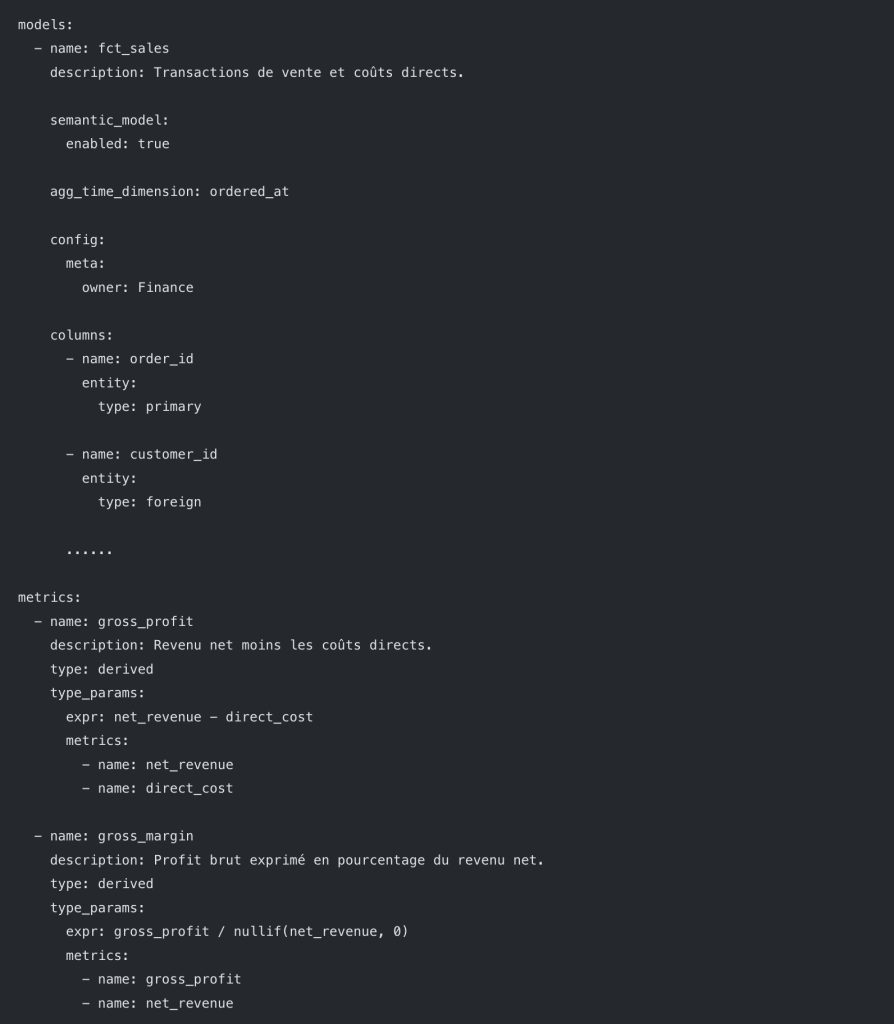
dbt moved data transformation out of graphical interfaces and turned it into a declarative asset.
The emergence of the Open Knowledge Format (OKF) illustrates this evolution well. In introducing this open standard, Google starts from a simple observation: despite the spectacular progress of foundation models, their main limiting factor is no longer their reasoning capacity, but their lack of context. To produce reliable results, agents need access to structured, portable, and interoperable knowledge rather than a collection of disparate documents or applications.
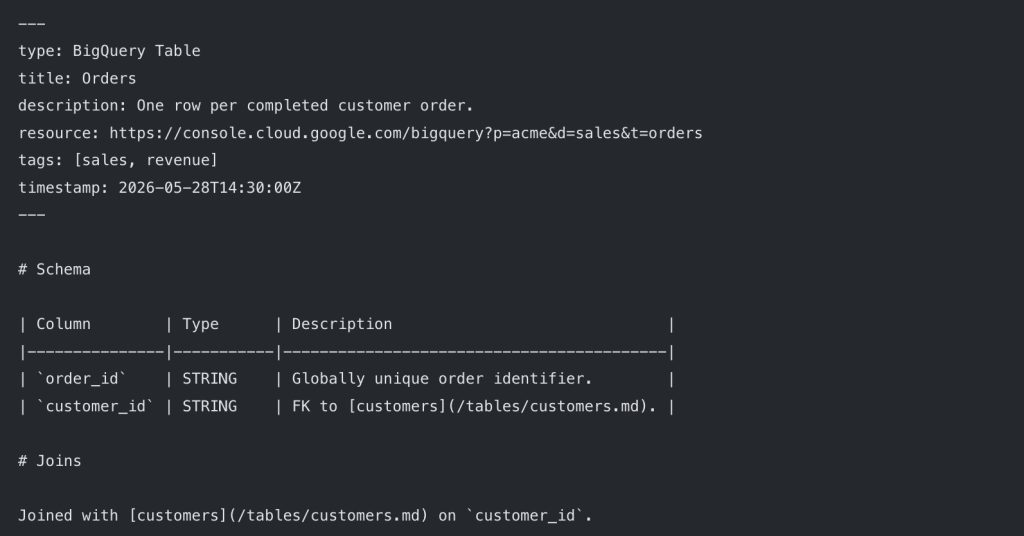
OKF pushes this logic one step further. Where dbt declares transformations and semantic layers declare metrics, OKF seeks to explicitly represent knowledge so that it can be understood, shared, and used by different systems, whether human or intelligent.
Yet despite these advances, one fundamental element remains missing: none of these approaches describe how an organization reasons from that knowledge.
A Concrete Example
When you observe an experienced financial analyst, you quickly notice that their expertise lies not just in their ability to read indicators, but in the way they reason. A drop in gross margin does not trigger the same analytical process as a rise in revenue or costs. Depending on the situation, they form different hypotheses, compare certain indicators, and apply investigation methods specific to their expertise. Yet this reasoning remains largely implicit today and is rarely represented in a structured way.
Ultimately, an organization should no longer settle for declaring its data and metrics (dbt) as well as data semantics (OKF): it must also declare its business reasoning.
When an agent needs to explain a change in gross margin, it no longer tries to reconstruct the business logic from dashboards or reports. It consults a declared representation of that method directly.
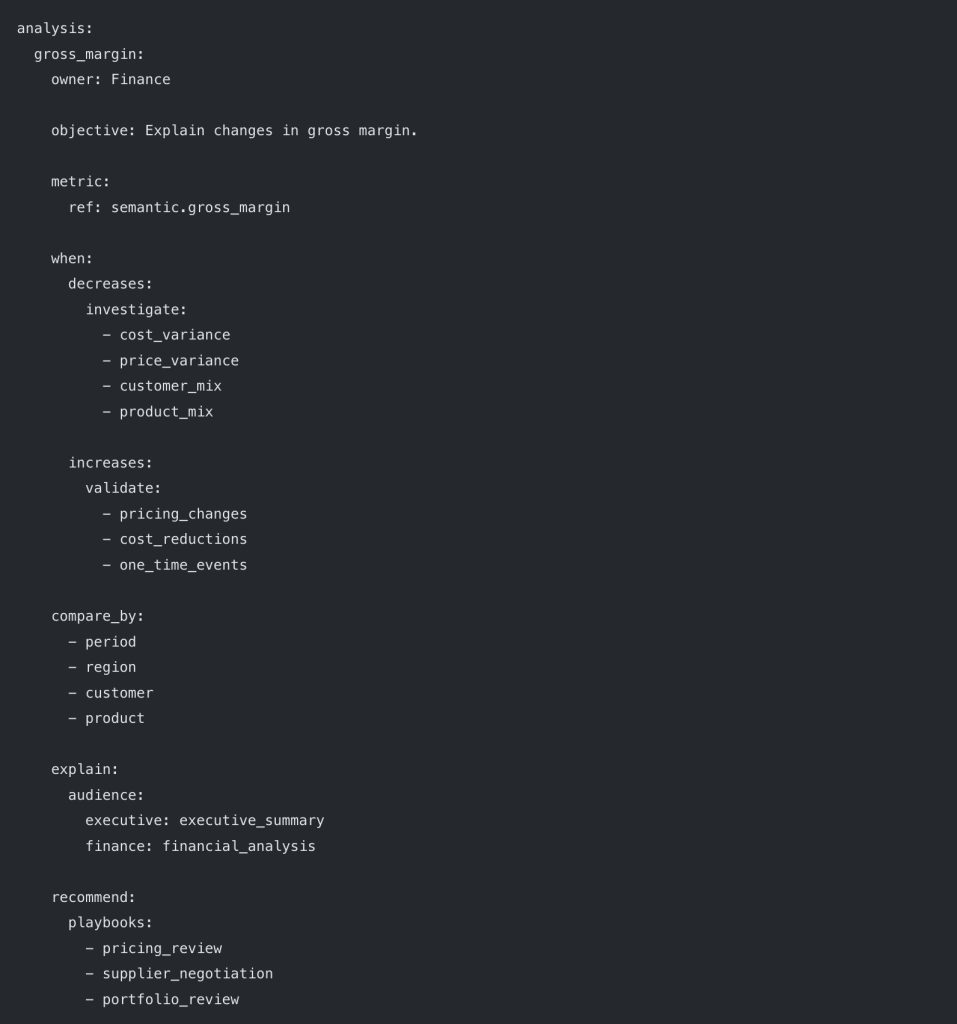
This representation could gradually extend to other fundamental concepts such as hypotheses, evidence, decisions, confidence levels, and escalation mechanisms. The goal is not to define a format, but to illustrate that it is becoming possible to explicitly represent intellectual activities that remain largely implicit today.

With this representation, the same reasoning can be executed by an agent, displayed in a dashboard, documented in an internal procedure, or reused by another team, without being reimplemented. This would be the foundation for an AI agent to produce interpretations that align with the organization’s DNA.
What Comes Next
For several decades, we have learned to declare our infrastructure, then our data, then our metrics, and more recently, our knowledge. I believe the next step in business intelligence is to declare the business reasoning itself. If this hypothesis is correct, then the primary deliverable of a BI platform will no longer be just a dashboard, but an explicit representation of how an organization understands, analyzes, and makes decisions.
Inscrivez-vous à l’infolettre Eficio et soyez le premier à recevoir notre actualité !