

In an economic climate marked by trade tensions, tariffs, and geopolitical uncertainty, Canadian companies face increased complexity. Supply chains are under pressure, supplier relationships are weakened, and operating costs are rising. In this changing context, the role of the CIO (IT Chief) becomes central to ensuring business resilience.

The CIO’s Role: a Key Player in Risk Management and Business Continuity
As trade wars change the rules of the game by creating a context of uncertainty, IT Chiefs (CIOs) must anticipate technological and operational impacts. This includes:
- Assessing vulnerabilities in the digital supply chain, particularly critical dependencies on foreign technology providers.
- Reviewing technology contracts to incorporate clauses for flexibility, data sovereignty, and operational redundancy.
- Implementing robust business continuity plans (BCPs), including cybersecurity, hybrid cloud capabilities, and critical system resilience.
Rethinking Supplier Relationships and Technological Sovereignty
The trade war is pushing IT Chiefs to reconsider their choices in outsourcing, hosting, and technology integration. The rise of concerns related to digital sovereignty, data control, and infrastructure ownership requires an increased level of due diligence. IT Chiefs must also:
- Conduct risk analyses on the ownership structure of suppliers (e.g., state-controlled companies).
- Promote local partnerships or those from stable jurisdictions.
- Integrate criteria related to environmental, social, and governance (ESG) factors, as well as regulatory requirements, into technology acquisition processes.
Identifying a Sovereign Cloud Partner: a Strategic Decision
In this context, choosing a Canadian sovereign cloud partner becomes a priority. IT Chiefs must rigorously evaluate providers based on criteria such as: Canadian ownership, exclusive data hosting in Canada, protection against extraterritorial laws (e.g., U.S. Cloud Act), and compliance with security and privacy standards. Collaborating with a sovereign provider such as ThinkOn, Micro Logic (C2 Enterprise Cloud) or TeraGo ensures greater control over strategic digital assets while strengthening the trust of internal and external stakeholders.
Accelerating Innovation to Offset Economic Tensions
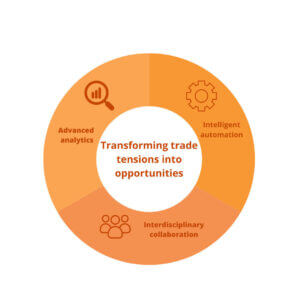
Rather than succumbing to the effects of trade tensions, IT Chiefs can transform these challenges into innovation levers. By focusing on:
- Advanced analytics to detect new market opportunities and better understand customer behaviors.
- Intelligent automation for efficiency gains, thus ensuring cost control.
- Collaboration between departments and specialties to redefine business processes and accelerate innovation cycles.
The CIO’s Role: Catalyst for Organizational Agility
Today, it is important to have rapid technology management to help businesses adapt through flexible digital platforms. The IT manager must align technologies with business objectives while monitoring external risks.
Conclusion
In a context where trade war is redefining the rules of competitiveness, the CIO’s role goes far beyond the technological function. They become a business strategist, guarantor of operational resilience, digital performance, and continuous innovation. By remaining proactive and adaptable, the IT Chief can help their organization not only survive but thrive in this new economic reality. Our CIO 360 service supports IT Chiefs in their strategic responsibilities related to continuity, governance, and innovation.