
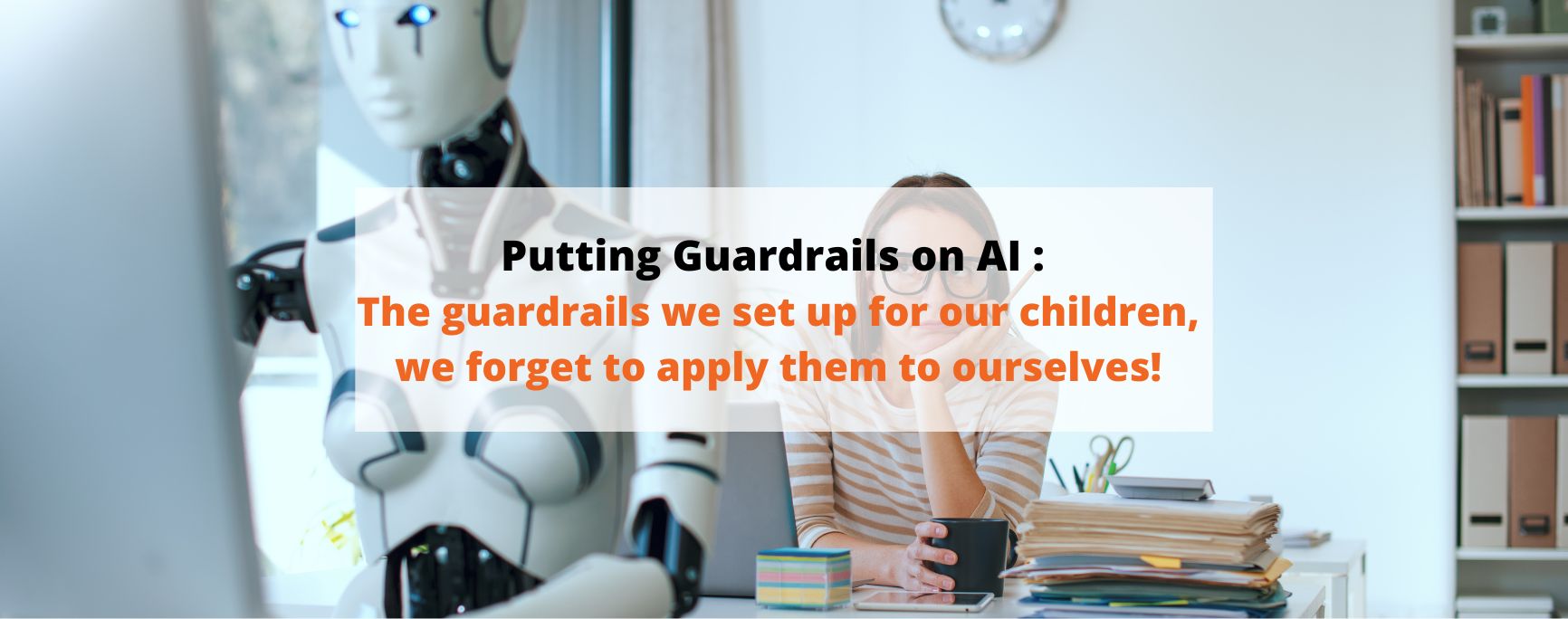
The guardrails we set up for our children, we forget to apply them to ourselves! Putting guardrails on AI shouldn’t stop at the schoolhouse door.

Putting guardrails on AI
The 2026 back-to-school season is unlike previous years: Google, Microsoft, OpenAI, and Anthropic are rolling out their assistants in schools across dozens of countries. Yet Natasha Singer, of The New York Times, points out that almost no serious study shows they improve outcomes, and that several point to a decline in critical thinking, for lack of proper guardrails.
Hence her question: a learning tool, or a classroom crutch, for lack of oversight?
Several countries are putting up guardrails. New York is banning AI for a year for its youngest students. Estonia goes further: an assistant that questions the student instead of doing the work for them, and a minister who champions guardrails against the loss of cognitive abilities.
The instinct is sound. We stop it at the schoolhouse door, with clear guardrails. Why?
The executive worried about their teenager opens the very same tool the next day, with no rules, for a memo, a decision. The dependence we fear for a fifteen-year-old brain takes hold just as readily in a forty-five-year-old manager, unsupervised, one of the most underestimated challenges of AI adoption in business.
The real issue isn't generational. It's organizational: that's where AI adoption needs to be structured.
The skill worth preserving isn’t using AI: it’s the ability to do without it.
In a business, dependence sets in through small delegations. First the writing, then the analysis, then the judgment: accepting or rejecting what the machine proposes. This is the dark side of convenience: you don’t flip all at once, you slide, surrendering your faculties one by one, until you can no longer recover your creativity or your resourcefulness on the day you must manage without it. An IT team, for example, that no longer challenges the tool would stop making decisions, for lack of real AI governance.
UNESCO frames the question from another angle. It holds that using a chatbot teaches you nothing, whereas the need to understand what these tools are and what they do to us becomes essential over the long term. That view applies equally to organizations. Training your people on prompts is pointless, and the constant evolution of the models drives an endless learning cycle. On the other hand, you could say that whoever keeps their hand in, the one who knows where AI accelerates without risk and where it slips in an error, will be in a better position. That’s the whole point of overseeing AI instead of being run by it.
AI undeniably saves time. But an organization’s value has never rested on its speed of execution, rather on the questions it asks, on its capacity for judgment and decision-making, a part that remains human and that alone justifies setting boundaries around AI use.
Over the coming decade, we can ask which organization will come out ahead: the one that kept its ability to function without AI, or the one that let AI take over the field until it no longer knew any other way? The first will have set up guardrails; the second will have put AI at the controls.
Shouldn’t we equip ourselves without delegating our thinking, accelerate without delegating our judgment, adopt AI without unlearning how to do without it? That, very concretely, is what putting guardrails on AI in business means.
Inscrivez-vous à l’infolettre Eficio et soyez le premier à recevoir notre actualité !