


In an environment where resources are limited and priorities are rapidly evolving, organizations must choose their projects carefully. A judicious selection of projects aligned with the strategic plan not only maximizes the contribution of each initiative to overall objectives but also ensures efficient resource allocation. This article explores the essential steps for choosing and managing priority projects to support the company’s strategy.
1. Defining Strategic Alignment in Project Management
The first step towards effective project selection is understanding strategic alignment. This means that each selected project must address the organization’s main objectives, whether it’s growth, innovation, profitability, or sustainable development. A project that doesn’t align with these priorities risks diluting the overall effort, adding costs and work without added value.
Defining strategic priorities involves clear communication at all levels, so that each project manager knows in which direction to focus their efforts. For this, leaders can use planning tools such as the strategy map, which helps visualize key objectives and the initiatives needed to achieve them. Each prioritized project should be linked to an initiative on the strategy map.
2. Methods for Identifying Priority Projects
Once strategic priorities are established, the most relevant projects must be chosen. This maximizes return on investment and avoids dispersing efforts.
The following diagram illustrates how project prioritization and selection are integrated into the activities of the project management office.
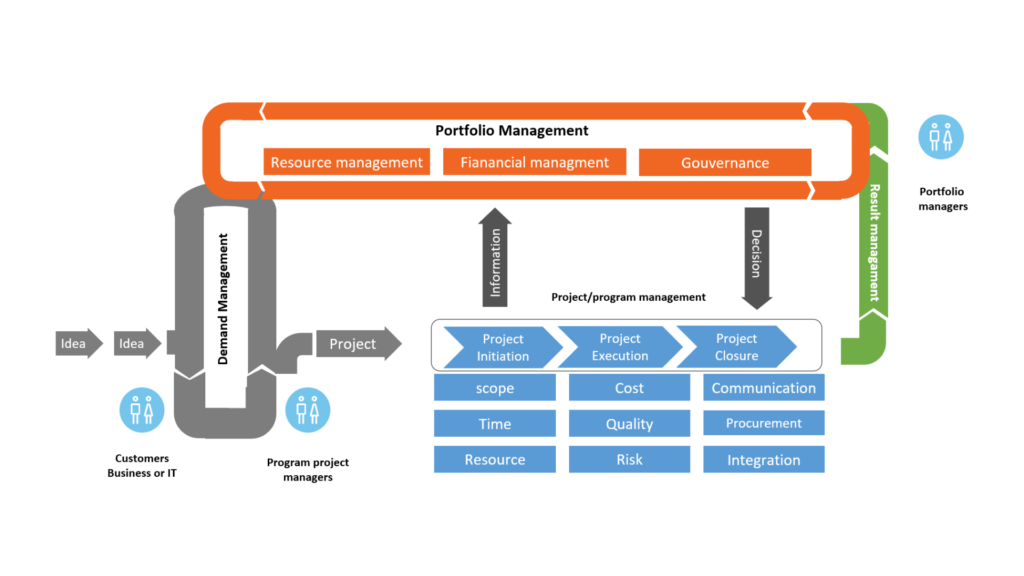
To choose the right projects, several methods exist. They allow filtering and ranking projects according to three criteria: their contribution to objectives, their feasibility, and their risk level. These tools facilitate decision-making and clarify the roadmap of priorities.
A. The Strategic Impact Matrix
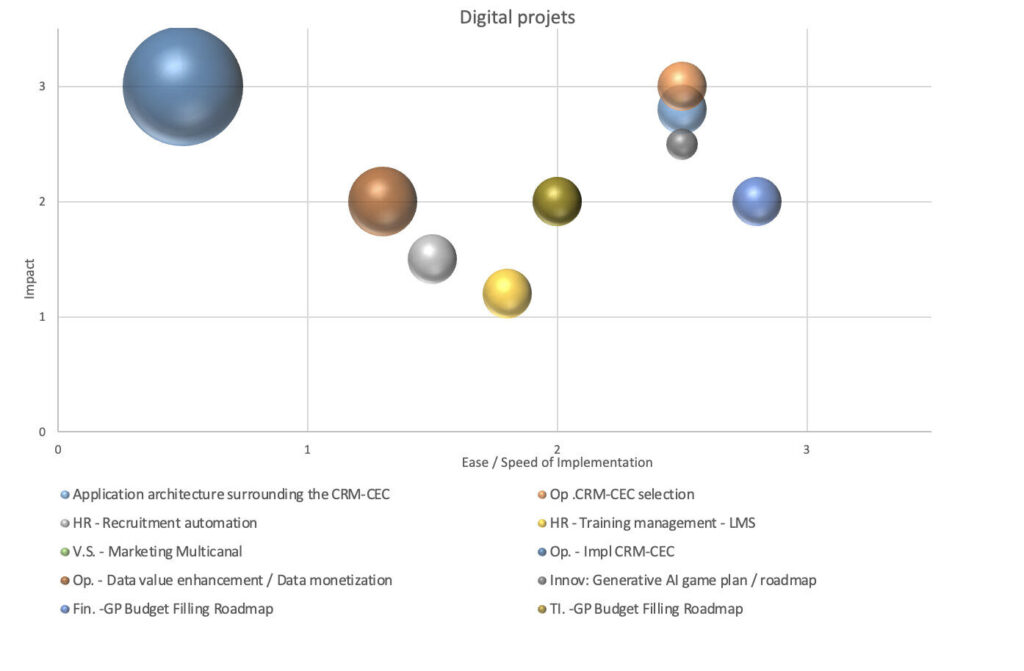
The strategic impact matrix is an effective visual tool. It evaluates projects according to two axes: their impact on objectives and their operational feasibility.
By placing each project in the matrix, those with high impact and high feasibility are easily distinguished. These projects are prioritized. Conversely, those with low impact or feasibility can be delayed or discarded.
Divided into four quadrants, the matrix helps prioritize according to resources and needs. “Quick wins” require few resources and bring immediate results. “Major strategic projects” demand more investment but support the long-term vision.
Example of a strategic impact matrix: In this example, Eficio has enriched the impact matrix by indicating in the size of the bubble the number of people potentially impacted by this project
B. Project Scoring
Project scoring is a quantitative method that assigns a score based on weighted criteria. These include: return on investment, strategic alignment, urgency, and required resources.
This approach standardizes evaluation and facilitates project comparison. By setting thresholds for each criterion, the company can better prioritize its initiatives.
One of its key advantages: it promotes collaborative and transparent decision-making. Each criterion is objectively evaluated, which strengthens stakeholder buy-in. Strategic choices are thus based on concrete data rather than impressions.
C. Value-added Analysis
Value-added analysis focuses on the unique contribution of each project. It assesses each project’s ability to create value for the company, whether by increasing revenue, improving efficiency, or strengthening market position. By using a value-added approach, the organization can target projects that have a tangible effect on its overall performance.
This method also encourages teams to identify and evaluate indirect benefits of projects, such as learning effects or potential synergies with other initiatives. A project that offers high value return can then be prioritized even if it presents technical challenges, as long as the potential gain justifies the investment.
D. Risk and Feasibility Assessment
Risk and feasibility assessment is a necessary complement to avoid strategic projects jeopardizing operations or consuming more resources than anticipated. By analyzing potential risks, such as technical constraints, resistance to change, and internal dependencies, the company can establish mitigation plans and avoid surprise effects that could delay priority initiatives.
By considering project feasibility alongside strategic importance, organizations ensure smoother execution. This also allows for planning fallback solutions for risky projects while maintaining a stable course on priorities.
E. Stakeholder Involvement in the Selection Process
Stakeholder involvement is crucial for validating project choices. By involving them in the selection process, a better understanding and greater adherence to decisions are ensured. Stakeholders, whether internal or external, bring varied perspectives that enrich project evaluation and allow anticipation of potential needs or resistances.
Collaborative scoring workshops or feedback sessions can be organized to obtain their insights, ensuring that selected projects meet the expectations of end users and managers, and are feasible within the company’s framework.
3. Optimizing Resources Based on Priorities
In a context of limited resources, it is crucial to allocate these resources optimally to priority projects. This means assigning budgets, time, and skills according to the strategic value of projects. To do this, a flexible planning is essential, as it allows for adjustments if unforeseen events occur.
This proactive resource management helps reduce bottlenecks where certain projects are blocked due to capacity constraints. Moreover, by maximizing the alignment of resources with priority projects, the company strengthens its operational efficiency and its ability to achieve its objectives.
4. Review Mechanisms and Priority Adjustment
Strategic priorities evolve. It is therefore essential to regularly reassess projects to ensure they continue to meet the organization’s objectives. Periodic portfolio reviews allow for checking project alignment and adjusting priorities if necessary.
This process, called ‘realignment’, allows maintaining the course on strategy while remaining flexible in the face of changes. In some cases, projects may be suspended or stopped if their relevance decreases compared to updated objectives, thus freeing up resources for higher value-added initiatives.
5. Success Indicators for Effective Strategic Alignment
Finally, it is important to measure the effectiveness of strategic alignment through performance indicators. KPIs (Key Performance Indicators) such as contribution rate to objectives, project cycle time, and profitability help evaluate whether the chosen projects truly contribute to the company’s results.
Rigorous monitoring of projected versus realized benefits allows for refinement of the project selection process for future initiatives. This data, analyzed periodically, provides valuable feedback that guides decisions and strengthens the effectiveness of the project portfolio.
In conclusion, choosing the right projects is a strategic lever for any organization wishing to optimize its resources and maximize its impact. By using continuous evaluation and review methods, companies can not only achieve their objectives in a more targeted manner but also position themselves agilely in the face of future challenges.