

Business Process Management (BPM) is much more than a one-off optimization exercise: it is a sustainable management philosophy focused on creating continuous value in a context of digital transformation.
In this article, we present the 10 fundamental principles that guide successful BPM implementation. These principles are the result of collaborative research between field experts and academics, complemented by Eficio’s field experience in supporting Quebec organizations.

Why should you care about business process management?
Business process management enables companies to better align their operations with their strategic objectives, while promoting organizational agility and continuous improvement. In a world where operational efficiency and digital innovation have become imperatives, BPM is becoming an essential discipline to master.
It is no longer just a matter of mapping internal activities, but rather of creating a shared and evolving vision of organizational performance. Business process management thus helps to orchestrate resources, technologies, and skills in the service of a better customer experience and modern governance.
A methodology based on expertise
The ten principles presented in this article are derived from a reference framework developed through focus groups involving 20 experts: 10 renowned academics from four international universities and 10 practitioners representing companies from various sectors (automotive, banking, engineering, construction, healthcare, logistics, etc.).
The researchers and professionals were selected for the diversity of their experiences, ensuring a holistic approach rooted in both theory and real-world practice.
Companies that successfully transform their processes are those that treat BPM as a cultural and strategic lever—not just a simple optimization task.
The 10 principles of business process management
Below is an illustration of the 10 principles of BPM. These fundamentals can serve as a compass to guide the implementation, diagnosis, or redesign of a process management program.
📌 See the summary table in the image below.
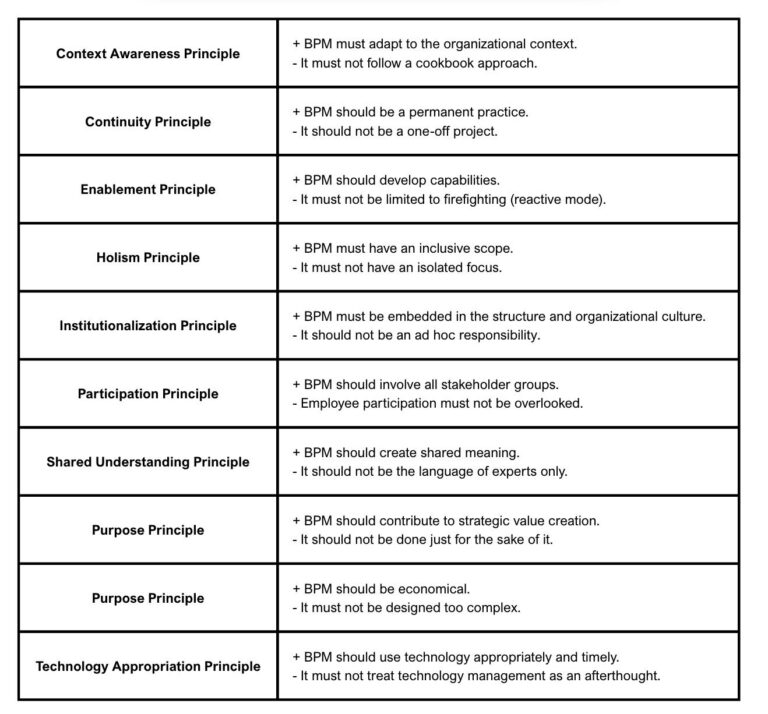
It includes key principles such as :
- Continuity : BPM should be seen as an ongoing practice rather than a temporary project.
- Participation : All stakeholder groups, including employees, should be included.
- Technological appropriation : BPM should incorporate the strategic use of technology.
- Simplicity and economy : Processes should be designed efficiently, without unnecessary complexity.
These principles apply to all types of organizations, regardless of their size or sector of activity. They are used both to structure an initial BPM approach and to audit an existing system.
How can you apply these principles in your organization?
The application of these principles depends on the organizational context: digital maturity, internal culture, degree of process complexity, etc. It is crucial to adopt a gradual approach, accompanied by transformational leadership and multidisciplinary involvement.
We support companies in :
- BPM maturity assessment
- Mapping and modeling of key processes
- Strategic and technological alignment of BPM
- Integration of BPM into overall digital governance
💡 Related to this topic :
Discover our related article: Motivations and characteristics of a BPMS platform
To go further
Business process management is a cornerstone of digital transformation. When implemented correctly, it enables organizations to become more agile, consistent, and resilient in the face of economic and technological upheaval.
Would you like to assess the maturity of your processes or launch a BPM project?
Book a free exploratory meeting with an Eficio expert and let’s discuss your goals.
Reference
- vom Brocke, J., Schmiedel, T., Recker, J., Trkman, P., Mertens, W., & Viaene, S. (2014). Ten Principles of Good Business Process Management, Business Process Management Journal (BPMJ).
- BPM reference site : BPMInstitute.org (en anglais)