


The 4 layers of enterprise architecture
The following diagram shows the layers of enterprise architecture:
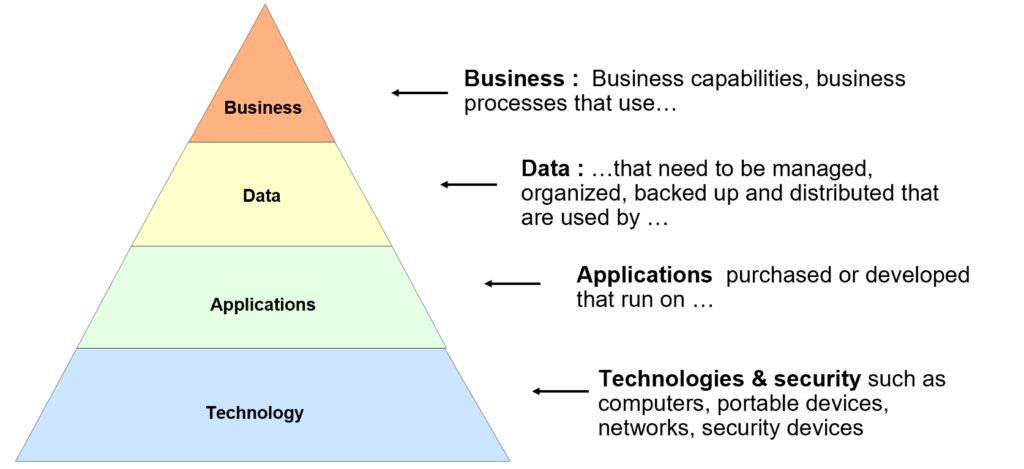
Both enterprise architecture and business process management improve alignment between business objectives and IT.
1. Business architecture and processes
Process architecture provides a framework for communication between operations and technologies in order to discuss and plan objectives, strategies, business capabilities, and required information. It provides a link between the company’s objectives and strategies and the processes and services provided by technology and the rules that support operations. Business capability modeling plays a major role in enterprise architecture. (See our article “Business Capabilities: A Powerful Tool for Your Strategic Planning”)
2. Data architecture
Data is the lifeblood of an organization. Successful data management requires much more than technological investments—it also requires processes and people to manage all aspects of the data lifecycle.
Data architecture defines how data is collected, stored, secured, and processed to support business processes. Your on-demand CIO can help you manage the entire data lifecycle to enable better decision-making, reduce risk, improve security, and increase productivity and operational efficiency.
3. Application architecture
When market demands change rapidly, a gap emerges between business needs and IT infrastructure. Application architecture is necessary to maintain a competitive advantage and agility in a competitive environment. Understanding your own application architecture is a prerequisite for maintaining agility. A consistent application architecture will allow you to quickly identify the organization’s technical needs and the capabilities available to support them, enabling you to better predict integration and support costs.
Your on-demand CIO can provide strategic guidance to the application integration team through a comprehensive understanding of all applications from the following perspectives:
- Interoperability capability;
- Links between applications, business processes, data sets, and underlying technology;
- Performance and scalability;
- Reliability and availability;
- Application lifecycle stage;
- Technological risks.
4. Technology architecture
Simplifying technological diversity enables your business to be agile. The technological architecture consists of database management components, security, servers, network security, etc.
Business capabilities – Critical link between strategies and IT
The following diagram shows that business capabilities are at the intersection between the company’s strategic plan and its enterprise architecture.
